
How we sold 1,043 winter units in summer with 22 emails and 7 texts
In short: We treated an out-of-season product as an awareness problem, not a seasonal one: the offer first to people who already owned it, then the objections in the order customers have them. When sales stalled we stopped for nine days and came back with education for a less-aware audience before the deadline. 1,043 units sold, $206K attributed, and the list grew.
Our client bought over 1,000 units of a winter item, in the middle of summer. Eight weeks later every unit was gone: 1,043 units, $206,167 in revenue, from 22 emails and 7 texts. We did it without scammy tactics, without ruining the relationship with the email list, and without spending tens of thousands of dollars on ads.
Conventional wisdom says 22 sends about one product in two months is how you destroy a list. Here's what happened instead.
The context: a loyal list, a seasonal business
The client is a family-owned outdoor retailer, decades in business and still run by the family: one destination store plus an ecommerce operation. Its customers are genuinely local and genuinely loyal. Many shop there monthly, and have for years, with staff who know them by name. That relationship ended up carrying the whole campaign.
We run their email and SMS in Klaviyo. When the campaign started, the list had roughly 55,000 engaged email contacts and 5,300 SMS contacts.
The business is deeply seasonal. Certain categories only move in certain months, and everyone (the store, the customers, the competitors) is trained on that rhythm. Winter gear sells in winter. Nobody expects to shift winter gear in June.
The challenge: three things stacked against it
The store's buyer was offered an exceptional deal on a cold-season product, good enough to retail it below anywhere else in the market. They took the whole allocation: over 1,000 units. Then the problem became obvious. It was June.
- Season. The product's natural selling window was five months away. Every instinct says to sit on it until then.
- Cash and space. Over 1,000 units of a bulky seasonal item is capital parked in a warehouse, doing nothing, in shelf space the in-season categories needed.
- Credibility. Promoting a winter item in mid-summer looks desperate. And if the price is that far below market, the first reaction is "what's wrong with it?"
The brief: move 1,000+ units of an out-of-season product, fast, without making the store look like it's dumping old stock, and without burning the list on twenty-plus sends about one product.
The approach: awareness, not season, as the buying trigger
The core decision was to stop treating this as a seasonal problem and treat it as an awareness problem. The normal buying trigger (it gets cold, you need one, you buy one) wasn't available. So the trigger had to be price and relationship instead. We mapped the list by how aware people were of the product and worked down it, most aware first.
Phase 1: the most-aware buyers
The first sends went to people who already owned the product: did they want another, one for a friend, or another size? No education, no build-up, just the offer. This is the part people usually get wrong. They open with their cleverest angle, when the most-aware segment only needs the offer, and it converts faster than anything else in the campaign.
Then: the objections, in the order customers have them
Once the announcement had run, we worked through the real objections, one at a time:
- "Why is it this cheap? What's wrong with it?" Emails explained that the units were brand new, current-model stock with the full warranty. The low price was a buying decision, not a defect, and the savings were passed on.
- "Is it actually cheaper than everywhere else?" A direct price comparison against what the same item costs elsewhere: the real market, not "was/now" against an inflated recommended price. We even found a real eBay listing of a second-hand one that had sold the week before for more than their brand-new price. Checkable proof.
- "Why are you selling me a winter product in July?" The one that mattered. We deliberately didn't explain it away with logistics. We framed it as a thank-you: a family store, a long history, the same faces coming through the door month after month, and a price you won't find anywhere else. It was true, and it turned a suspicious-looking promotion into a gesture instead of a pressure tactic.
The channel mix
- Plain-text emails for a large share of sends. They land in the inbox more often and read like a person, not a retailer.
- Designed emails where the message needed to be visual.
- SMS for people who don't open email: seven texts, each with a 30–34% click rate.
Before launch, a win-back campaign reactivated 9,500 inactive contacts, so more of the list was live to see the offer when it went out.
Sales were tracked on a live dashboard every day against the target, not in a report after the campaign. That let us tie every move, up or down, to the exact send that caused it.
The turning point: nine days of silence, then a different campaign
Around week four, sales fell off a cliff: from 184 units in the best week to 89, then 77, 76 and 66.
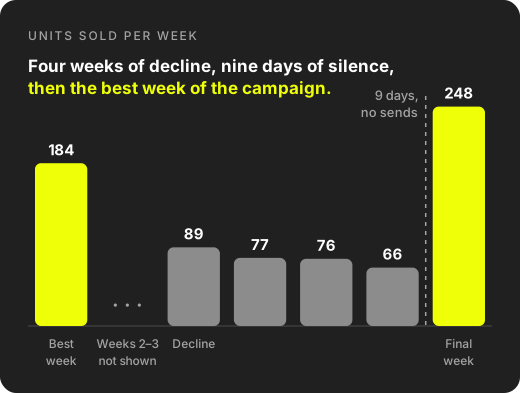
It would have been easy to read that as "the offer is spent." It wasn't. We had exhausted the most-aware audience: everyone who already knew the product and wanted one had bought one, and we were still sending announcement-style messages to a pool with nothing left to announce.
So we stopped. For nine days, there were no sends about this product at all, to rebuild instead of hammering a dead segment. What came back targeted a different audience further down the awareness ladder:
- education instead of announcement;
- outcome stories instead of features;
- anticipation as the urgency ("everyone will be scrambling for one at full price soon") instead of immediate need.
Then, and only then, the hard deadline.
The spike at the end isn't the deadline working. It's the education working, with the deadline collecting.
The final week sold 248 units, more than the best week of the launch, after four weeks of decline: a 276% jump on the week before. When you send a deadline email, you should already know it will produce sales. A deadline doesn't persuade anybody of anything. It only tips over people who were already convinced. If the less-aware audience hasn't been walked to the edge of the decision first, there's nobody standing there to tip.
The result: 1,043 units, gone before the season they were bought for
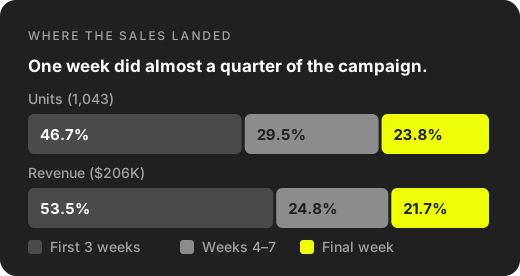
The list didn't burn
The result we're arguably proudest of: 22 emails about one product, and the list came out healthier than it went in.
Spam complaints stayed at or below 0.12% throughout, and the SMS list grew 18.1% over the same period. A cross-sell send to the buyers afterwards made $3.02 per recipient, 10–30 times the per-recipient revenue of the main list sends. That tells you what the new buyer segment is worth from here on.
What to take from it
- Start with the people who already know the product. The most-aware segment only needs the offer, and it pays for the rest of the campaign.
- Answer objections in the order customers have them: price, then proof, then "why now".
- When sales drop, check the audience before the offer. A falling curve often means a segment is exhausted, not that the offer stopped working. Pause, then go further down the awareness ladder.
- Use the deadline to collect, not to persuade. It only works on people you've already walked to the edge of the decision.
- Protect the list while you push it. Plain text for the inbox, SMS for people who don't open, and a daily dashboard so every send has a number next to it.
Over 1,000 units of capital and warehouse space were freed up before the season they were bought for, and a stock-clearance problem became a customer-appreciation moment.